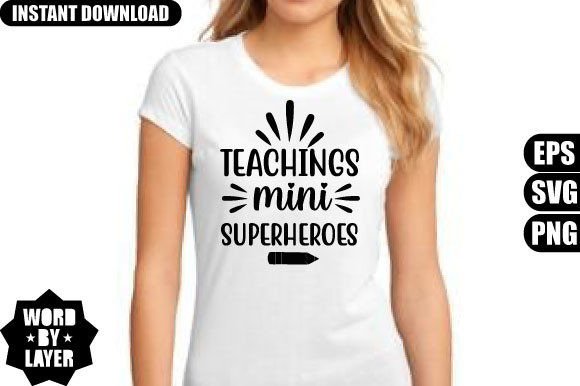
Teachings Mini Superheroes SVG Design
A Designer’s First Look: Playful, Purposeful, and Ready for Real Stitches
When I opened Teachings Mini Superheroes SVG Design, my first thought wasn’t “cute” — it was “usable.” As someone who’s digitized over 300 school-themed embroidery files and shipped embroidered tote bags to teachers across three states, I scan for balance: visual charm *and* stitch integrity. This design lands cleanly in that sweet spot. The mini superhero figures — capes fluttering, tiny fists raised — sit beside clean, friendly lettering (“Teach,” “Learn,” “Grow”) in a compact, circular layout. It doesn’t shout; it smiles with quiet confidence. That makes it ideal not just for T-Shirt Designs, but for thoughtful handmade products where personality meets professionalism.
How It Actually Embroiders: From Screen to Stitch
I tested Teachings Mini Superheroes SVG Design on a midweight cotton twill tote bag — the kind Etsy sellers love for back-to-school teacher gifts. With a standard 4×4 hoop and medium-weight cutaway stabilizer, the satin-stitched capes held crisp edges, and the fill-stitched bodies retained soft definition without puffing or bleeding. The running-stitch outlines added subtle dimension without overloading density. On a lightweight baby onesie? I scaled it down 15% and switched to tear-away stabilizer — still legible, still charming. No thread nests, no skipped stitches. That’s rare in school-themed graphics, where busy icons often collapse under dense fills.
Where it shines brightest is in context: think embroidered aprons for classroom cooking days, pillow covers for a new teacher’s nursery, or patches sewn onto denim jackets for student leadership teams. It’s small enough for a child’s cap brim (with careful hooping), yet bold enough to read clearly on a folded tea towel. I also mocked it up digitally on a heather gray sweatshirt — the contrast worked beautifully, especially when paired with a warm mustard or navy thread. That versatility matters if you’re building a craft business around consistent, recognizable design assets.
Where to Proceed With Care
- Stretchy fabrics: Avoid using Teachings Mini Superheroes SVG Design directly on ribbed knits or performance tees without testing. The tight curves in the capes and letterforms can distort if the fabric shifts mid-stitch — always use adhesive + cutaway stabilizer here.
- Dark or textured backgrounds: On black terry cloth towels or fuzzy fleece, the fine details (like the tiny star on a cape) may soften. Consider simplifying those elements manually or opting for bolder thread colors (white, neon yellow) to maintain clarity.
- Curved surfaces: Caps and curved pockets demand precise placement. I recommend stitching a test version on a scrap cap panel first — the compact layout helps, but even slight misalignment makes the symmetry feel off.
- Small hoop sizes: While it fits comfortably in a 4×4 hoop, pushing into a 3×3 means trimming detail — especially the delicate “S” in “Superheroes.” Don’t force it unless you’ve confirmed the file allows clean scaling without collapsing strokes.
What It Adds — and What It Doesn’t Promise
This isn’t a high-density showstopper meant for gallery wall art. It’s a grounded, human-scaled machine embroidery design built for real life: quick turnaround, low thread consumption, and clear emotional resonance. When stitched on a linen kitchen towel as a holiday gift for a first-year teacher, it landed exactly right — warm, encouraging, and unmistakably handmade. Customers notice that. They trust it. It supports brand consistency for small shop owners who sell coordinated “teacher care kits” (tote + towel + embroidered pin). And yes — it performs well in printable mockups for Etsy listings, especially when shown on light and dark fabric swatches side-by-side.
What it doesn’t do? Pretend to be something it’s not. It’s not an applique design with layered fabrics. It’s not optimized for photorealistic shading or metallic thread effects. It’s a clean, vector-based digital embroidery file — purpose-built for clarity, speed, and kindness in both message and execution.
Practical Notes Every Embroidery Designer Should Check
- Always run a test stitch on scrap fabric matching your final product’s weight and texture.
- Review stitch density in your embroidery software — if fill areas exceed 18–22 stitches/mm², consider lightening density for baby items or lightweight apparel.
- Confirm the file includes layer separation (as noted in “WORD BY LAYER SVG FILES”) — essential for custom color sequencing or monochrome versions.
- Check thread color contrast on both light and dark mockups before sending to production.
- Use proper stabilizer: cutaway for knits, tear-away for stable wovens, and fusible + tear-away for nap-free fabrics like linen.
- Verify licensing terms before selling finished embroidered products commercially — this is a DIGITAL DOWNLOAD ONLY, and commercial use rights must be explicitly granted.
- If offering personalized gifts, confirm how easily the text elements (e.g., “Teach”) can be edited or replaced — SVG flexibility helps, but embroidery-ready files need clean anchor points.
Final Thought: A Quiet Workhorse for Meaningful Makes
Teachings Mini Superheroes SVG Design won’t dominate a tradeshow booth — but it will earn repeat orders from boutique owners who value sincerity over spectacle. It fits naturally into the rhythm of a craft business: quick to digitize, reliable to stitch, and resonant enough to become part of someone’s daily ritual — whether that’s a teacher sipping coffee from an embroidered mug or a child tracing the cape on their backpack before class. In a market flooded with generic “Back to School svg” bundles, this one earns its place by doing less, but doing it well. That’s the mark of good Graphics — and better design judgment.